AI assistants are starting to screen for shoppers: how can small businesses clarify their brand facts when future customers let machines filter first?
A shopper can use an AI assistant that searches the live web to help compare products and services. Nir Wegrzyn, writing in Fast Company, argues that conflicting claims across channels can make it harder for an AI system to understand a brand. A small business can start by checking that its services, opening hours, and fee notes match on its website, its business profile, and its social pages, so people and machines can read them more easily.
Why the first stages of buying are changing
People used to click through search results page by page. Some shoppers now ask an AI assistant with live web search to filter options and suggest a business that may fit. Here, an AI agent means a software assistant that can look things up and take steps for a person. Helping someone search and compare is different from making a purchase on their behalf with their permission.
From clicks to an AI summary and a first shortlist
On 14 November 2026, Nir Wegrzyn, chief executive of BrandOpus and a Fast Company contributing writer, wrote that more of the early stages of future buying decisions will be handled by AI agents. He adds that the first screening a brand faces is extending from end customers to machine assistants.
Morgan Stanley’s US e-commerce forecast
A forecast is not money already spent. In a brief dated 8 December 2025, the investment bank Morgan Stanley forecasts that, by 2030, US e-commerce spending influenced or driven by AI agents could reach US$190 billion to US$385 billion, about 10% to 20% of the US e-commerce market. That 2030 forecast is for the United States only, not for Hong Kong, Canada, or the world. In its US survey, shopping assistants were still less common than general large language model platforms, meaning general AI systems that answer in text. Wide use still depends on the products and on how shoppers’ habits change.
Building on the author’s views: 3 checks on brand facts
The three checks below bring together Wegrzyn’s views on brands and public guidance from Google and Schema.org. They are this article’s practical suggestions, rather than three points listed by Wegrzyn or rules followed by every AI platform.
Check 1: Machines need facts they can retrieve
People respond to design and to words that carry feeling. A web-connected AI system cannot sense how a package looks. Wegrzyn reminds a brand to appeal to people and also to make its meaning readable to a machine. This article suggests stating the service specification, the qualifications, and the promises in clear public text. That does not mean an AI system uses only text or structured data.
Check 2: Conflicting claims may weaken a recommendation
Wegrzyn’s view is that conflicting opening details or fee promises, across a website, a business profile, and social pages, may look unclear when an AI system cross-checks them. It may then prefer a competitor whose public facts are more consistent. This article suggests checking those claims first. That suggestion is not a measured rule of every AI system.
Check 3: A clear identity helps a machine
In search systems, a knowledge graph connects facts about a business or other subject. A clear name, address, line of work, and responsible person help a machine connect the right facts. Guidance from Google and Schema.org on LocalBusiness, a way to describe a local business in page code, covers names, addresses, and similar facts. This article suggests checking the visible content first, and adding markup—page code that describes business facts—only where it helps. The guidance does not promise to end confusion between businesses that share a name, or to win an AI recommendation.
Offer people real value, and write facts a machine can read
Small businesses can keep their existing marketing while making their public information easier for machines to read.
Trust for people, clear facts for a machine
People still pay for and use the service, so tone, expertise, and reputation still matter. An AI assistant also needs machine readability: consistent public text that states the service steps, how fees are set, and the questions customers often ask.
A hypothetical service-business situation
This is a hypothetical situation, not a measured result, and not a finding about Hong Kong or Canada. A customer might ask an AI system for three nearby renovation firms and compare service area, fees, and guarantee terms. The firm can write those facts clearly, then ask the same question and read the description. Inclusion and accuracy still have to be tested.
4 practical steps to make brand facts easier to find
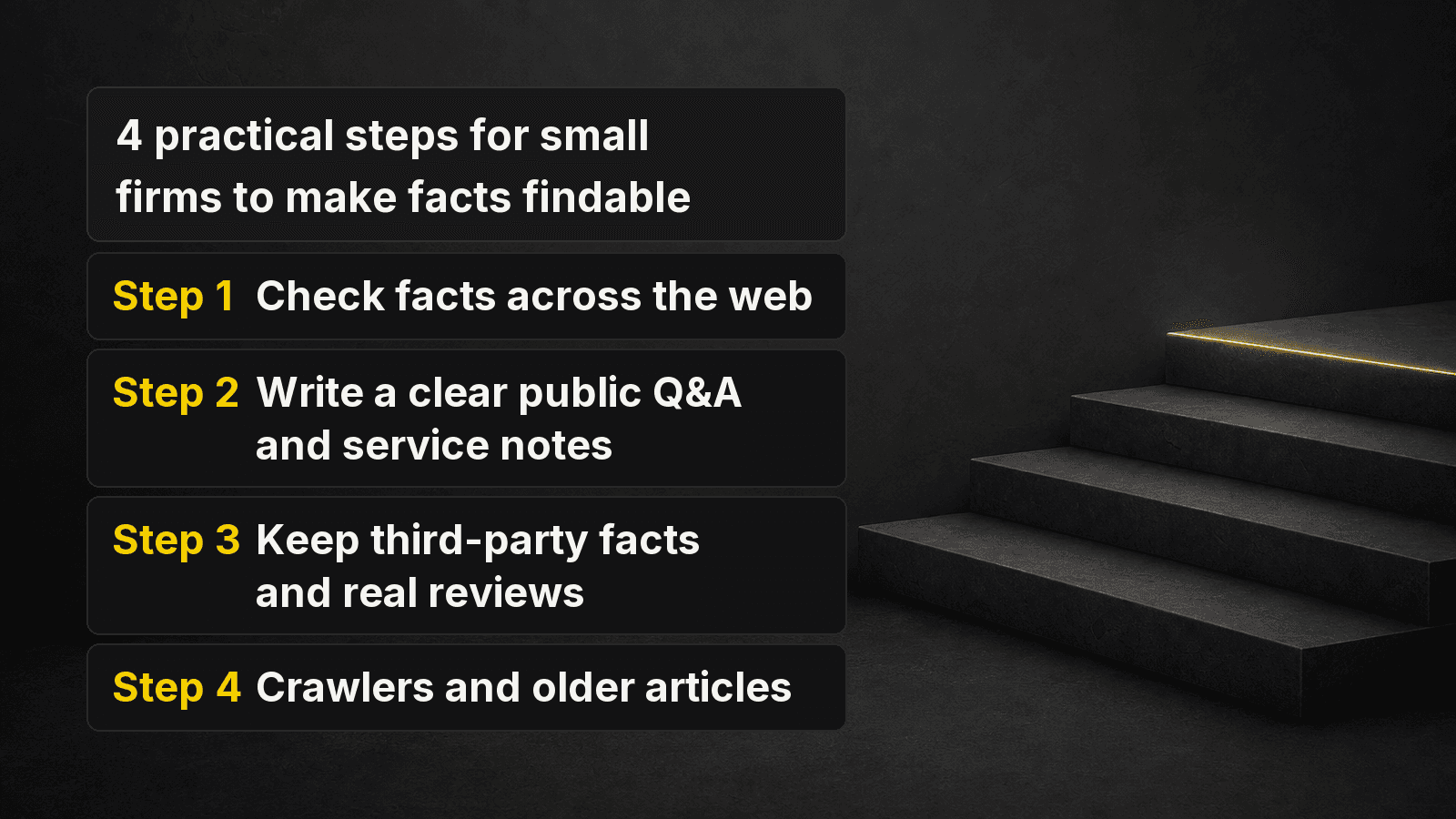
This work is answer engine optimisation, or AEO: arranging public information so an answer tool can find and read it. It is steady operations work. These steps do not promise an AI recommendation.
Step 1: Check basic facts across the web
Check the name, address, and phone number (NAP) and the opening hours on the website header, footer, and contact page, on the Google Business Profile, and in industry directories. Remove an old address, an old number, or a service area that does not match.
Step 2: Publish plain questions and service notes
State, in plain language, how pricing works, what the steps are, and what is not included. Where it helps, add structured data, meaning page code that puts business facts in fixed fields. JSON-LD is one common format. In a study published on 11 May 2026, Ahrefs tracked 1,885 pages that added JSON-LD. In its tests of Google AI Overviews, AI Mode, and ChatGPT, citations did not rise by a large amount. AI Overviews and AI Mode are Google features that summarise answers. Google says a site does not need markup made only for those features, and that existing markup should match the visible text.
Step 3: Maintain third-party facts and real reviews
On 10 November 2026, Ahrefs studied a US sample of ChatGPT questions. Recommendation and comparison questions in that sample more often cited review sites and advice sites. That is not a fixed preference of every AI system, and it does not prove that new Google reviews raise the chance of a recommendation. A business can check third-party pages and invite genuine reviews for other people to read.
Step 4: Allow search crawlers, and link older articles
Check the server and robots.txt, the file that tells crawlers which pages they may fetch. OpenAI’s OAI-SearchBot and Perplexity’s PerplexityBot are search crawlers. OpenAI’s GPTBot is a training crawler. Those permissions are separate. Allowing a crawler is not a promise of a recommendation. Crawler settings and four information sources are covered here: Where does ChatGPT get its information? Four sources, taken apart.
Brand-fact consistency checklist
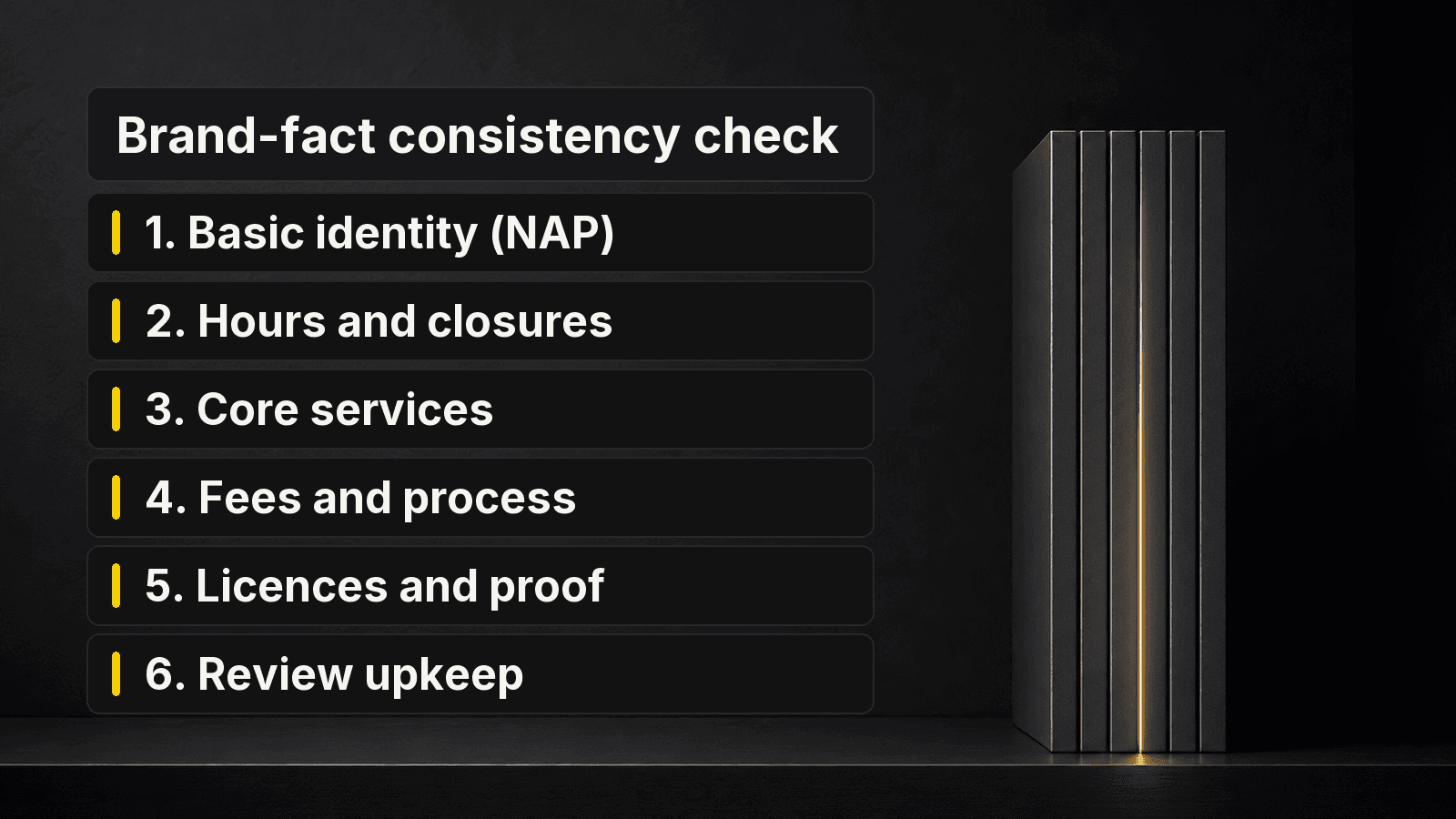
| Check | What to compare | A common mismatch | What to fix |
|---|---|---|---|
| 1. Basic identity (NAP) | Name, address, and phone on the website, business profile, and social pages | Old address after a move, or a phone extension that does not match | One contact format and one street address |
| 2. Hours and closures | Google Business Profile, website homepage, and a pinned social post | Website says open all year; profile says closed on Sunday | Keep holidays and hours in step |
| 3. Core services | Main services and the area served | Vague wording, or a retired service still listed | Drop expired items; list current services |
| 4. Fees and process | Price structure, quotes, payment, and acceptance terms | Website says the consultation is free; a social page lists a fee | One charging rule, with no clash |
| 5. Licences and proof | Licences, permits, association credentials, and insurance | Expired licence still listed, or no registration number | Licence name, number, and issuer |
| 6. Review upkeep | Genuine comments, and the business’s replies | Unanswered negative reviews, or very few reviews | Invite reviews and reply with care |
AEO is ongoing work, not a one-off trick
AEO can start by tidying facts a business already publishes. It is not a shortcut to sudden attention.
Many founders are already busy. They rarely have time to check public channels for mistakes, keep structured data current, or see how AI search tools describe the brand. AHA Solutions’ AI search optimisation service helps service businesses in Hong Kong and Canada check whether public facts are consistent, organise important pages, and track AI search performance against the questions agreed in advance. Whether a brand is cited or recommended still depends on the platform, the question, and the result at that time. The AHA AI search service page describes that basic review.
Frequently asked questions
Q1: Is AI shopping, or screening on the shopper’s behalf, already the mainstream way people buy?
The research cited here does not establish that either is mainstream today. Helping someone search and compare is different from making a purchase on their behalf with their permission. Morgan Stanley’s 2025 US research brief says shopping assistants are still less common than general large language model platforms, and that wide use still depends on products and on habits. That brief is not enough to say whether either mode is already mainstream in Hong Kong, in Canada, or in every market today.
Q2: If a website has Schema structured data, does that guarantee an AI recommendation?
No. It does not. Structured data, such as Schema.org LocalBusiness, mainly helps a search engine and its systems read the meaning of fields on a page. Ahrefs’ study did not find that adding this markup, on its own, brought a large rise in citations in the Google AI Overviews, AI Mode, and ChatGPT tests it ran. A business can first check its public content, its facts across platforms, and its real reviews. That is this article’s organising advice. It is not a proven formula for an AI recommendation.
Q3: If time and money are tight, where should a small business start with AEO?
Start with a basic inventory. On the website, the business profile, and the main social pages, check the name, the address, the phone number, the services, and the fee notes. Then turn the questions customers often ask into pages that are easy to read. This low-cost tidy-up can make the information clearer for a potential customer and for a retrieval tool. It does not promise a recommendation.
Sources
| Claim in this draft | What it says | Source | How to read it |
|---|---|---|---|
| Fast Company article | “The most important shopper of the future isn’t human.” Author: Nir Wegrzyn, BrandOpus chief executive. Date: 2026-11-14. His view: more of the early stages of future buying decisions may be handled by AI agents, and conflicting claims can make a brand harder for an AI system to understand. | https://www.fastcompany.com/91635595/the-most-important-shopper-of-the-future-isnt-human-ai-agents-shopping | A brand strategist’s view, not a fixed rule of any AI platform. |
| Morgan Stanley forecast | By 2030, US e-commerce spending influenced or driven by AI agents could reach US$190 billion to US$385 billion, about 10% to 20% of the US e-commerce market. In that US survey, shopping assistants were still less common than general large language model platforms. Wide use still depends on products and habits. | https://www.morganstanley.com/insights/articles/agentic-commerce-market-impact-outlook (brief dated 2025-12-08) | A US forecast and a US survey summary. Not a present size, and not a Hong Kong, Canada, or world figure. |
| Consistent facts across channels | Conflicting claims may make a brand harder for an AI system to understand. Checking basic facts first helps readers and retrieval tools. | Wegrzyn’s view, as carried in the Fast Company article above, plus this article’s practical suggestion | Author’s view plus this article’s suggestion. Not a fixed result of any algorithm. |
| Ahrefs study of ChatGPT sources | In that study’s sample of US ChatGPT questions, recommendation and comparison questions more often cited review sites and advice sites. | https://ahrefs.com/blog/where-does-chatgpt-get-its-information/ (2026-11-10) | One US sample. Not a fixed weight in every AI system, and not proof that new Google reviews raise the chance of a recommendation. |
| Ahrefs study of schema and citations | The study followed 1,885 pages after JSON-LD was added. In the Google AI Overviews, AI Mode, and ChatGPT tests it ran, citations did not rise by a large amount. | https://ahrefs.com/blog/schema-ai-citations/ (2026-05-11) | Those tested surfaces only. Not a test of every platform, and not a promise of a recommendation. |
| Google’s AI features and websites | Google’s AI Overviews and related AI features do not need markup made only for them. Markup that is present should match the visible content. | https://developers.google.com/search/docs/appearance/ai-features | Official guidance. |
| Google Business Profile | Accurate business facts, including address and service area, are part of the profile guidance. | https://support.google.com/business/answer/3038177 | Official guidance. Not a promise of an AI recommendation. |
| LocalBusiness fields | LocalBusiness markup can describe name, address, phone, and area served. | https://developers.google.com/search/docs/appearance/structured-data/local-business and https://schema.org/LocalBusiness | A way to describe facts. It does not promise to remove name confusion or to win a recommendation. |
| OpenAI crawlers | OAI-SearchBot is for search. GPTBot is for training. The permissions are separate. | https://developers.openai.com/api/docs/bots | A technical access condition. Not a promise that allowing a crawler leads to a recommendation. |
| Perplexity crawler | PerplexityBot is the search crawler described in Perplexity’s documentation. | https://docs.perplexity.ai/docs/resources/perplexity-crawlers | Separate official documentation. |
| AHA’s current service | Help with access to material, organising pages, checking consistency, and tracking retrieval performance. The sentence in this draft follows the Chinese draft: Hong Kong and Canada service businesses; citation or recommendation still depends on the platform, the question, and the result at the time. | https://www.ahasolutions.ca/zh-TW/ai-search | Service wording follows line 111 of the Chinese draft, including Hong Kong and Canada. No extra promise is added here. |
| Local service example | A customer asking for three nearby renovation firms. | Hypothetical scenario (no external source) | Marked in the draft as a hypothetical situation. Not a statistic, and not a Hong Kong or Canada finding. |
| Existing AHA article | Crawler settings and four sources behind ChatGPT’s answers. | https://www.ahasolutions.ca/zh-TW/insights/where-does-chatgpt-get-its-information | Public article linked from the Chinese draft. |
Production note: This article was prepared by AHA Solutions.